01
Strategic Coherence
- A clear why
- Sharp positioning
- Explicit trade-offs
- A 3–5 year ambition
Where do your strategy, brand and organisation need to work better together?
The Brand–Culture Engine is a diagnostic framework I developed from twenty years in marketing and management, to explore the connections between your business direction, your market promise and the way your organisation works. Start with the self-assessment. Use the result to reflect on your business, compare perspectives with your team or begin a conversation with me.
Most diagnostics add points. This one multiplies and divides, because that is how organisations actually behave. A sharp strategy and a brilliant market position get divided by silos, conflicting KPIs, unclear decision rights and a leadership team that is not saying the same thing.
That is also why friction is squared in the model. A company that is excellent on every other force but heavily blocked inside still loses close to a third of its score — friction cuts deep without cancelling everything else.
Friction is the hidden killer. It rarely appears in a strategy document, it never appears in a marketing plan, and it quietly consumes the returns on both.
Which is why, in most growth-stage companies, the highest-leverage move is not a campaign. It is alignment, friction reduction, and execution discipline. Marketing amplifies afterwards — and amplifying a misaligned company only makes the misalignment travel faster.
Laid out the way the model calculates them: three forces on top, friction underneath the line — squared — and one that multiplies the result.
The denominator, squared. The only variable that makes everything else worth less — and it counts twice.
The equation above is the Brand–Culture–Performance model: three forces multiply, friction divides — squared, so it weighs as much as two variables — and execution discipline multiplies whatever is left. It is a way of structuring a diagnosis — of asking the right questions in the right order — not a measurement instrument and not a law of performance.
Your answers are scored on each of the five areas and combined, using the model, into an index out of 100 and a company pattern. It is an indicative self-assessment based on your answers. It does not independently measure company performance or replace research, a full diagnostic or professional judgement.
The four minutes are a starting point: first for a conversation with your management team, then with me — to look at your specific context, choose the approach that fits and unblock the growth path.
When eight people from the same management team answer the same questions, the average is the least interesting output. The spread is where the money is.
A high average with a wide spread is the most common and most expensive pattern in growth-stage companies: a team that agrees on the words and disagrees on the reality. Everyone signs off on “solutions partner”. Nobody has the same picture of what that means on a Tuesday.
Answers are anonymous. That is not a legal footnote — it is the condition under which people tell you something you did not already know.
The online diagnostic gives you one reading: yours. The team assessment puts every reading side by side, and I run it with you. Ask about a team assessment.
Fifteen behavioural questions about what actually happens in your company, not self-ratings. About four minutes, on a phone if that is easier. No email needed to see your result.
Your index out of 100, the five variables scored, your company’s archetype, and the three moves with the highest leverage for a company shaped like yours. Yours to keep.
People in the same organisation can experience the same strategy very differently. A facilitated team assessment helps us examine those differences, understand the situations behind them and decide what needs attention. Before starting, we agree how responses will be collected, reported and discussed.
Discuss a team assessment →
The Brand–Culture Engine is one tool within my broader approach.
Depending on the brief, I combine it with interviews, customer or employee research, market analysis and working sessions. The next step may involve positioning, marketing, employer branding, management development or a specific implementation issue.
We choose the work based on what we find.
Explore my consulting services →A distributor moving toward a solutions and service model. Real technical depth, real market demand, own brands with genuine margin potential — and growth that kept arriving harder than it should have.
Market Relevance never moved. It was already the strongest variable in the business. Everything in that jump came from identity clarity, sales behaviour, operational simplification and leadership cadence.
Marketing was never the growth lever here. It was the amplifier waiting for something worth amplifying.
An explicit decision to stop describing the company as a distributor. A portfolio and a set of priorities that reflected it, and the discipline to kill the initiatives that did not.
The brand claimed “solutions partner” while the commission plan rewarded transactional volume. Culture follows the incentive, not the claim.
Clear segment ownership, defined sales stages, escalation rules, and an answer to the question nobody had written down: who approves what.
A monthly strategic dashboard, segment-level visibility, a KPI cascade by function, and one named owner per initiative.
“It was the starting point for rethinking how we organise our work, collaborate and lead our teams.”Commercial Director, at the close of a four-month leadership programme
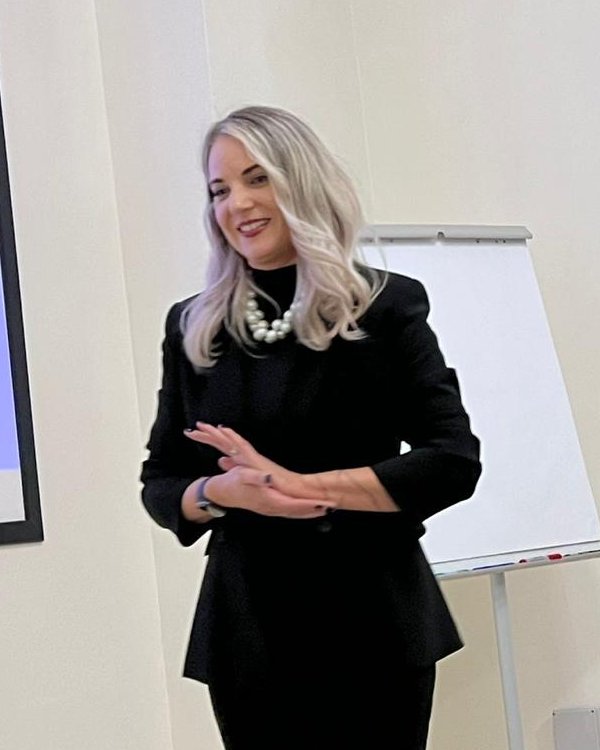
I am Georgiana Iancu. Since 2006 I have worked at the intersection of brand, marketing, organisational culture and leadership — the four things this model refuses to treat separately.
I spent a decade inside a multicultural technology company, the last five years of it leading communications: three-to-five-year communication strategy, employer branding, a management communications framework, and budgets between €70k and €450k. I ran the communication through the company's acquisition by a German group listed in Frankfurt — which is where I learned what a strategy document is worth when the organisation underneath it has not caught up.
Since 2020 I have worked in independent practice — six years now — through InkingBrands and Brandocracy, with Romanian entrepreneurial companies in growth, repositioning or transformation. The work sits with owners, CEOs and management teams, and in the same week with the sales, HR, marketing and operations people who have to make the decision real.
My method is warm in the room and direct in the diagnosis. I ask uncomfortable questions gently, and I do not leave a session without decisions, owners and dates.
I do not think I could have found a more suitable person with whom to analyse my work, challenges and development as a manager. With patience, consistency and clear procedures, I believe I can move from being the firefighter to becoming the fire brigade commander — building a system that solves problems instead of putting out every fire myself.
This leadership programme meant much more than a course or a series of workshops. It was the starting point for rethinking how we organise our work, collaborate and lead our teams — laying the foundations for a more structured, coherent and performance-oriented approach.
The most hands-on workshop, with the clearest direction, that we have had since we started working together. I appreciated that we stayed focused, that you gave us concrete feedback and that the guidance was clear.
Testimonials translated from Romanian and shortened for length. Client names withheld by choice; original messages and attribution available on request.
Four minutes, fifteen questions, and a result you keep whether or not we ever work together.
Want your whole management team assessed? Get in touch
Questions about the method, the diagnostic, or running the assessment with your whole management team — leave your details and I will reply personally.